BM25 walkthrough
Jul 2026 3 min read
How BM25 scores documents - rarity, term saturation, and length normalization — the three ideas that make it a default ranker for search and RAG.
- IR
- search
BM25 is a probabilistic ranking function that is widely used in Information Retrieval (IR) and search engines (ElasticSearch or Hybrid Search in RAG).
It’s an evolution of traditional TF-IDF (Term Frequency - Inverse Docuemnt Frequency) designed to fix TF-IDF main weakness: unbounded term frequency scaling and bias towards longer documents.
Core Formula
For a query Q consisting of terms q1, q2, q(n), and a candidate document D, the BM25 score is computed as follows:

Where:
- is the frequency of query term in document .
- is the length of document (total word count).
- is the average document length across the entire corpus.
- and are free hyperparameter constants.
IDF Component
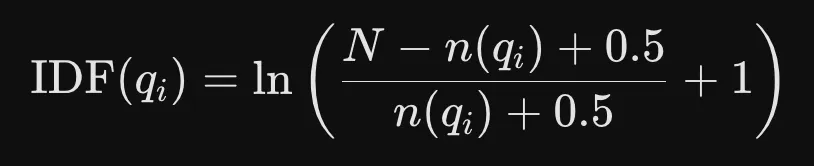
Where:
- is the total number of documents in the corpus.
- is the number of documents containing the term .
| Parameter | Typical Range | What it Controls | When to Increase |
|---|---|---|---|
| k1 | 1.2−2.0 | Term frequency saturation speed. | When multiple occurrences of a term in a long text genuinely add more relevance signal. |
| b | 0.75 | Sensitivity to document length. | When your corpus has highly variable document lengths and long texts tend to dilute relevant content. |
Recap:
BM25 depends on 3 pillars:
-
Rarity: The rarer the word, the higher the score. A rare word acts as a heavy weight multiplier, while a common word is down-weighted to near zero. BM25 handles it by using the IDF (inverse document frequency) method.
-
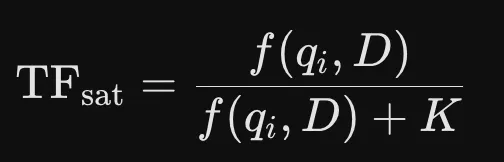
Term Saturation: Handles instances where seeing a query word once indicates that the document is relevant. Seeing it 3-4 times confirms that it’s heavily focused on that topic. Seeing it 100 times usually means someone is “keyword stuffing” to game search rankings.
- The Knob:
- Low (e.g., ): The curve flattens out very quickly. After or mentions, extra occurrences add almost no extra score.
- High (e.g., ): The curve approaches a linear scale, allowing documents with high term counts to continually gain higher scores.
- The Knob:
-
Length Normaliation: Longer documents have two unfair advantages in pure keyword matching:
- Higher raw term frequency: A 10,000-word document naturally repeats key terms far more often than a 200-word summary.
- Multi-topic dilution: A long document might cover 20 different topics and happen to mention your query term in passing, whereas a concise 100-word abstract might be 100% focused on your query.
- Without length normalization, long documents dominate search results simply due to sheer word count.
